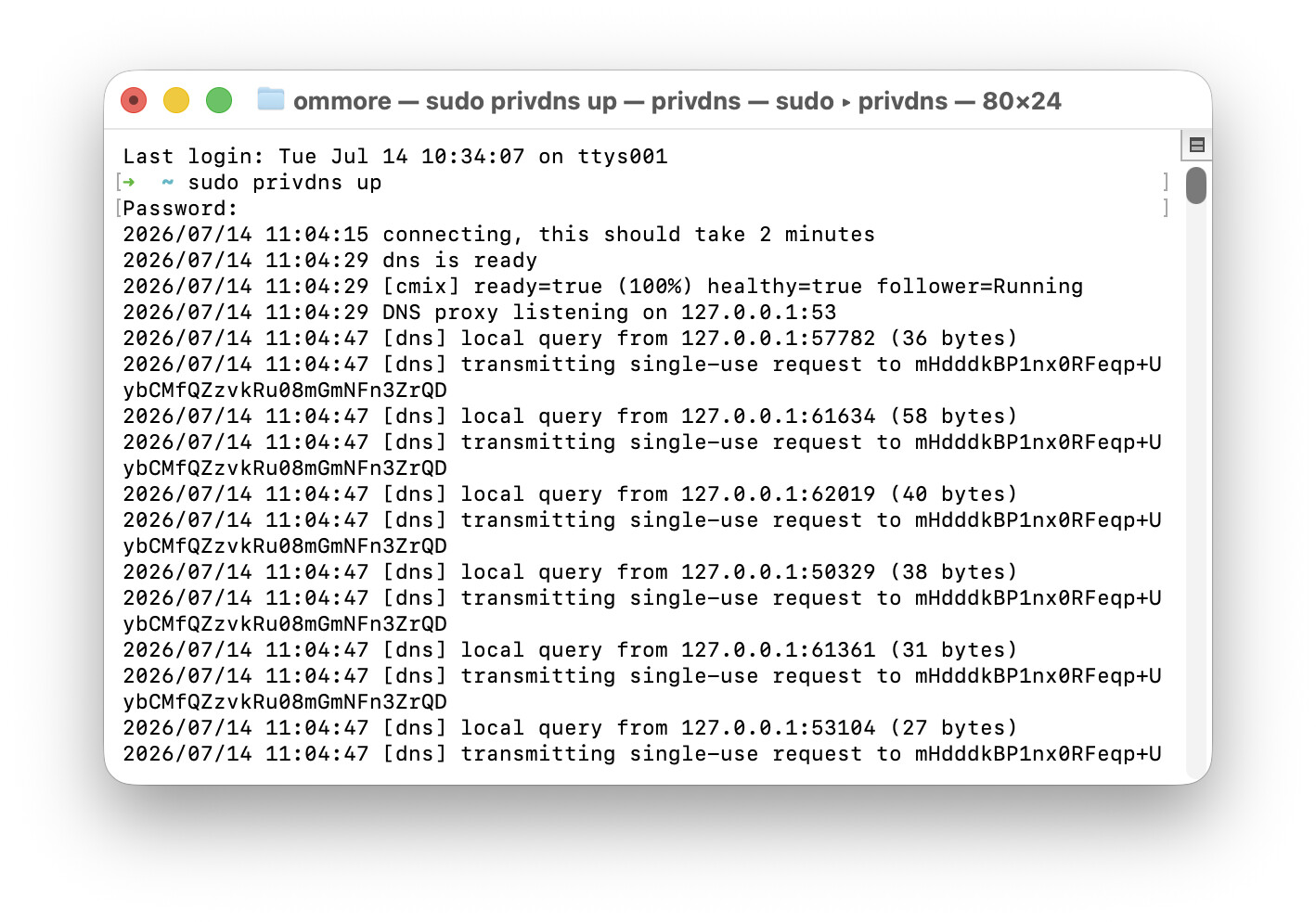
So far, the experiment has not worked as expected. macOS sends many DNS queries, while cMixx needs some time to respond. This creates timeouts and makes the setup unreliable.
I’m not sure yet whether this can be solved, but I’ll keep researching it.
Feedback from the xxNetwork team and community would be appreciated.
Feel free to try it on your system and let me know if you see different results. Note - only test if you know how to get back to original dns, since this can break your internet.
It’s an interesting idea, but due to DNS client behavior it may be impractical.
From a privacy perspective, you’d need a trusted DNS server, so most likely you’d use your own, I assume?
Back when I cared I setup WireGuard to home server, where I’d query own DNS server (with privacy-focused upstream DNS). That worked well.
If you have to run your own, a WireGuard or even Haven-over-Onion seems like a much easier approach that works almost out of box…
cMix seems more suitable for use cases that use HTTP(S) and can tolerate 10s of latency in each direction. News/blog feeds and AI chat seem like better use cases.
From the repo:
This project is built against the cMix v4 API. Because Keith’s fork declares module path gitlab.com/elixxir/client/v4
Sigh… I have seen this in several xx repos. I hope Gitlab has been worth all the usability troubles, although it doesn’t seem that way to me.
By default, the client routes through a server I host.
When the client sends a request, each one gets its own cMix identity. That means the server sees every request as coming from a different, anonymous sender, even multiple queries from the same client appear completely unlinked.
Personally I am fine with anyone trusted hosting server since the server can’t tell which requests came from the same person, and the query content alone should not be enough to link back to me.
That said, the mixing only works well if enough people are using it. The more traffic going through, the harder it becomes to distinguish anyone’s activity.
I don’t think that is issue, only thing is latest fixes and performance improvements seems to be in Keith’s fork. I have to use go replace to make sure that repo is used.